Zenescope - Omnibusted #49: Neverland Completely Omnibusted

a.k.a. The Omnibuster.
Yes, I'm doing the whole Thunderbolts* thing because this technically isn't a compilation of my thoughts on everything Neverland-related ever (because I haven't gotten to all of it yet). There is another Neverland miniseries that I will cover when I get to the Age Of Darkness event, Cross will participate in several other books and miniseries (call them Cross-overs, if you like) in the interim, including Realm Knights, and the Realm Of Wonder and Imagination will feature in several miniseries with Zenescope's "street-level" heroines beyond what I originally read (I think I stopped reading around the time the original Grimm Fairy Tales run and the Wonderland Ongoing series ended).
When I first decided to turn my Neverland reviews into a chronological compilation in September 2024, it just happened to be the late Jason David Frank's birthday, and new information came to light about the continuity and genealogy of the Neverland franchise since I re-read the Family History short story that left me confused and disappointed about what I previously believed were the facts of its world. So I revisited the 2008 Annual and my review of the seven-issue Neverland series to put things into perspective, much like what I have done for characters like Cindy Monroe and Samantha Darren in the past.
Now, here I am again after reading Neverland: Hook, with yet more new information that potentially re-frames the order of events as previously established, so I'm going to do it all again like a good dance-monkey should.
As follows, the Tales From Neverland, 2008 Annual, and Neverland miniseries continuity still stands as is. But The Dream Eater Saga and Hook chronology from that point are now in question, and I will get to that later.
For now, this is a long one, so I'm keeping in the opening call to action where I ask that if you enjoy these kinds of continuity-focused posts, or if you don't enjoy them, or you have no opinion at all, please remember to Become A Ticketholder if you haven't already, leave a comment at the bottom of this post and any others you have opinions about, help out my ad revenue as you read so I can continue to afford adulting, and follow me on BlueSky, Tumblr, Facebook, Instagram, Pinterest, YouTube, and LinkedIn to like what you see and receive the latest news on content like this.
Let's start with where it all began....
Tales From Neverland Bonus Story: Family History (Part 1)

To be clear for The Algorithm, that was sarcasm. Racism, slavery, murder, and world domination are bad things, and I do not advocate bad things (my qualified praise for Mushoku Tensei notwithstanding).
Getting back to the story that matters today, eight days after learning that her husband is a controlling, murderous Highborn supremacist, Penelope takes their son, Jacob, on board the Titanic, where they are followed by one of Phillip's henchmen who doesn't get named because he won't make it much farther into the page count. Several allusions are made to Jacob being a continuation of Phillip's legacy (and one reference to Phillip having a second son), which confused me in the early pages of this story because I thought it was going to follow Mary and Daniel Darling in their days before the 2008 Annual, instead of two new characters.
This is not where Part One ends, but I'm cutting the reprint short here to revisit the 2008 Annual in greater detail, particularly on the backstory of Mary and Daniel because I'm not worried about spoilers anymore.
GFT Annual #2 (2008)

Sela is here, seen in fractional dress and almost unrecognizable due to the art style, which is reminiscent of The Little Mermaid and Queen Of Hearts vs. The Mad Hatter. It quickly becomes clear that she is not here in a storytelling capacity, as Morrigan is the real focus character, much as he was in the Rip Van Winkle issue (which an Editor's Note offers in reference to "Sela and Death's relationship". This, combined with Morrigan's choice of glamour and Sela's...sleepwear, shall we call it, hint that the two may have been romantically involved at some point, though whether genuine feelings were involved or it was simply emotional manipulation on his part (he's done it to Sela before and will again) is mostly unclear, as he has been shown in the Rip Van Winkle issue and in Volume Nine to vacillate between sad affection for Sela and conflicted villainy to get what he wants).
He puts on another face for an encounter with a flower-obsessed woman named Mary Setab (that’s Bates backwards), cuing a twist on Mary, Mary, Quite Contrary, wherein a woman named Lily becomes jealous of her married lover and steals his catatonic wife’s wedding ring, not knowing that every woman who steals a piece of her jewelry gets turned into a flower. Or murdered by the fake-catatonic wife. Or something. The imagery is clearer on that point than I originally thought, but the surreal, morbid nature of it blurs that line for the reader. The following scene confirms that Mary Setab is the fake-catatonic woman, and she refers to the flower she had been coddling as Lily, which is much more clear.
This concept of women being turned into flowers has been a recurring theme in the Wonderland titles, even including an issue (Mad Hatter part 2) featuring another woman named Lily. It’s doubtful this is anything more than a coincidence, but it’s fun to notice these things.
Putting on yet another face, the Reaper meets up with a woman named Rebekah, the wife of infamous serial killer/doctor Humphrey “Humpty” Dumpty, whom she tried to put back together Frankenstein-style after all the king’s men beat him within an inch of his life.
The final story is the most important for our purposes here, and is titled "Hush, Little Baby." As Morrigan wanders the deck of the as-yet-unknown ship (though in Retrospective, his allusions to the "screams," "cramped hallways," and other bits of foreshadowing are pretty masterful writing hints that it's the Titanic), musing about how he struck a bargain with a man during "the war" who ended up causing the Black Death, claiming that he will never again spare a life (this text partially obscured by a page number in the second Volume of Different Seasons because care and effort have been sacrificed for the sake of budget and time) when he discovers a mother and son stowed away in a lifeboat. Shocked that she can see through his glamour (or dispel it altogether?), he offers to keep them a secret and the story proper begins. "Hush Little Baby" focuses on Henry Malady (yes, really) and his wife (not named in the story, but revealed later). Henry had an extramarital affair with a "voodoo woman" and abandoned her and their child, so she cursed his son with an insatiable, cannibalistic hunger (with reference to the boy eating a mockingbird, among other animals, to make the nursery rhyme fit). When Henry locks Daniel in the cellar and goes to fetch the constable and have him sent to the asylum, Henry's wife unlocks the cellar. So upon Henry's return, he is eaten by Daniel, and mother and son flee with "a ship to catch" (because emphatic bold in comic books will never make sense).
This concept of women being turned into flowers has been a recurring theme in the Wonderland titles, even including an issue (Mad Hatter part 2) featuring another woman named Lily. It’s doubtful this is anything more than a coincidence, but it’s fun to notice these things.
Putting on yet another face, the Reaper meets up with a woman named Rebekah, the wife of infamous serial killer/doctor Humphrey “Humpty” Dumpty, whom she tried to put back together Frankenstein-style after all the king’s men beat him within an inch of his life.
The final story is the most important for our purposes here, and is titled "Hush, Little Baby." As Morrigan wanders the deck of the as-yet-unknown ship (though in Retrospective, his allusions to the "screams," "cramped hallways," and other bits of foreshadowing are pretty masterful writing hints that it's the Titanic), musing about how he struck a bargain with a man during "the war" who ended up causing the Black Death, claiming that he will never again spare a life (this text partially obscured by a page number in the second Volume of Different Seasons because care and effort have been sacrificed for the sake of budget and time) when he discovers a mother and son stowed away in a lifeboat. Shocked that she can see through his glamour (or dispel it altogether?), he offers to keep them a secret and the story proper begins. "Hush Little Baby" focuses on Henry Malady (yes, really) and his wife (not named in the story, but revealed later). Henry had an extramarital affair with a "voodoo woman" and abandoned her and their child, so she cursed his son with an insatiable, cannibalistic hunger (with reference to the boy eating a mockingbird, among other animals, to make the nursery rhyme fit). When Henry locks Daniel in the cellar and goes to fetch the constable and have him sent to the asylum, Henry's wife unlocks the cellar. So upon Henry's return, he is eaten by Daniel, and mother and son flee with "a ship to catch" (because emphatic bold in comic books will never make sense).
Later, back on the Titanic, Morrigan breaks his "I will never again spare a life for any reason" rule and gives them a bag of gold for their new life, with the mother revealing for the first time that her name is Mary Darling.
Shortly, Belinda appears, and Morrigan gives her the Book Of the Lost for the first time, saying that he could have given her Sela's book instead, which she declines. In Morrigan's narration following the sinking of the Titanic, he makes note of Sela finding a new pair of spectacles (presumably to tie into some of the cover art of the time, though that and the use of glasses or spectacles in the issues themselves would be inconsistent, and a later retcon would solidify Sela's glasses as a part of her history and design).
Now, let's get back to why Family History was following a new mother-and-son-on-the-run (Penelope and Jacob) instead of Mary and Daniel Darling.
Tales From Neverland Bonus Story: Family History (Part 1), Continued....
This is quickly remedied when Jacob "makes a new friend" onboard the Titanic (this boy's identity subtly confirmed by the pair's poses in their game of tag),
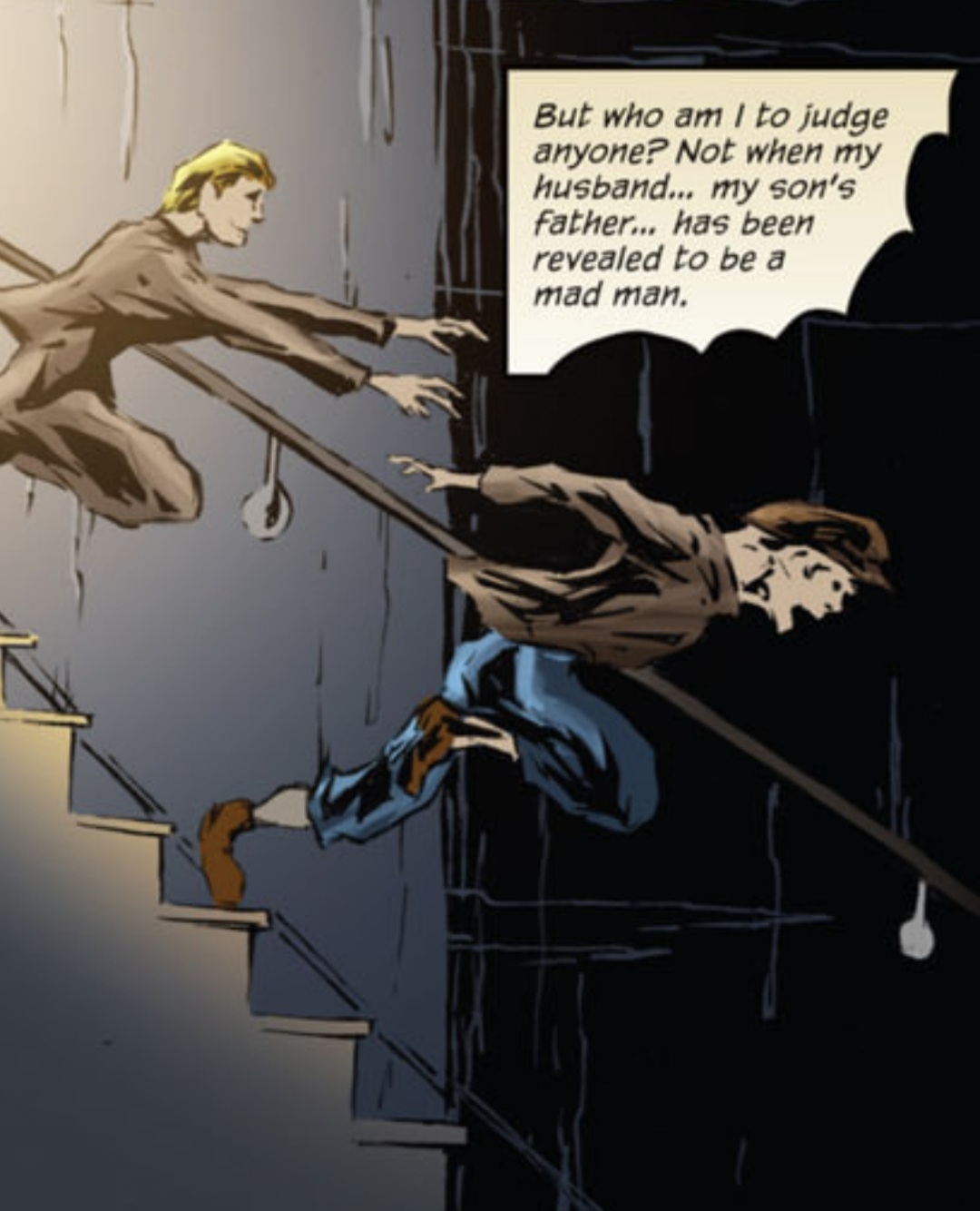
Flash ahead to April 18th (three to four days after the sinking of the Titanic), and we see that Penelope (who is pregnant), Jacob, Mary, and Daniel are among the survivors, and they are heading for America (which Morrigan foresaw when he gave Mary the gold for "the New World"). I almost gave this a Jason Takes Manhattan inaccuracy rant, but I looked up the location of the wreck, and I can kind of believe that a life boat could make it to the Northeast coast of the United States in four days (plus, I forgot that the 2008 Annual said they were picked up by rescue ships), so let's move on to Part Two.
Tales From Neverland Bonus Story: Family History (Part 2)

Omnibuster's Note: Penelope has some narration in this part where she refers to Jacob's brother as Michael (a name we previously—or later, if we're going chronologically instead of by publication order—saw in Neverland as one of the Darling boys whom Wendy comes to rescue from Pan), which is revealed in the third part of this story to be a printing error. I originally thought Vincent was just some random neighborhood friend because of this error ("how will Jacob and Michael eat?"), which only compounded my confusion and disappointment as Family History closed in on its final twists. Also, questions arise because of my third read-through of the Annual, as Daniel makes it seem like they came to New York (and that neighborhood, specifically) because Mary knew about Neverland, that Daniel's voodoo curse was somehow tied to Neverland, and that there was a portal here, and somehow got her hands on enough fairy dust to activate it multiple times.
A decent mystery emerges as to whether Jacob or Daniel will be Pan, when Malec approaches Jacob and offers him dominion over Neverland. There's also a few panels of a grey-skinned fairy and the rhino guard from GFT #49 (along with silhouettes of what could be Hakan and two other indigenous extras) discussing the slaughter of fairies by the Horde and "The Beast," and ordering the closing of all portals between the Realms and the Nexus (which was mentioned in Shang's exposition dumps in previous GFT issues). Unable to visit Neverland, Jake snaps and kills his stepfather while Daniel is shown eating...something...in the sewer and Malec watches, offering Daniel a "reward" (that we never find out what it is) as the second part ends.
Tales From Neverland Bonus Story: Family History (Part 3)

Also, Malec tricks Daniel into heart-fisting Vincent to death, and suggestively takes credit for sinking the Titanic (probably by having Morrigan and Belinda do it for him), offering Jacob the usual "resources for revenge in exchange for mutually beneficial and unconditional servitude" bargain.
So...who is Daniel to the story at this point? This spin-off franchise at large, and this bonus story, specifically, are so "fuck you" about making their lore satisfying or their villain characters deeper than an atom of paper pulp (or, as we will see shortly in Neverland's chronology, treating their female supporting characters with any kind of artistic dignity or narrative appreciation—Tiger Lily being the temporary exception to the narrative appreciation rule), that Zenescope would rather do nothing with the property for half a decade (aside from having crossover event villains cannibalize and/or slaughter everyone...twice) than explain the reasoning behind the three-year cock-tease that was Daniel's mere existence in Grimm Universe continuity.
Family History looks on par with the main Neverland series and GFT issues of its time (even giving me quality whiplash with the hard transitions at the end of the Tinkerbelle and Tiger Lily issues), and my opinion of the narrative was heavily influenced by my over-caffeinated emotional state at the time of writing, but I absolutely fucking hate it with every ounce of passion I possess and every ounce of passion that I find lacking in the Neverland brand to this point in the Retrospective.
Tales From Neverland #3: Croc

The Disney telling of Captain Hook's origin is similar to what transpired in J.M. Barre's original novel and play, but some major liberties are taken in the Zenescope version (which has the best art of the three Tales, and makes one wonder why the female-focused issues—the reviews of which I have reprinted and edited following this, in accordance with covering events in chronological order—looked so bad by comparison or if it was merely an issue-by-issue stylistic choice by the art team).
Things open with the pirate Captain Arcos in the midst of sending his crewmen (specifically one man named Gregor, who doesn't make it past the second page) to the island home of a Lake Placid/SyFy Channel-sized crocodile to retrieve a treasure he stashed there.
Things open with the pirate Captain Arcos in the midst of sending his crewmen (specifically one man named Gregor, who doesn't make it past the second page) to the island home of a Lake Placid/SyFy Channel-sized crocodile to retrieve a treasure he stashed there.
Arcos is dressed in a legally distinct red pirate ensemble and Pan (formerly Jacob, for an unknown length of time, though Arcos mentions having picked him up as a young thief and beggar somewhere in Neverland) and Nob are on his crew, so you know immediately that his chances of survival are on par with those of a horny asshole of color in a slasher movie, but a comic book has pages to fill, so plot must plot.
Pan claims to have a plan to get around the Croc, and Arcos' crew (including a background character who looks like Sagat with tribal tattoos)

And that's pretty much it. As a non-speaking character who dies by the end, the Croc is a tertiary presence in its own story, and the abrupt ending leaves little in terms of a satisfying arc or any hints at how this affects whatever Pan's frog-ass-flat villain scheme was prior to "kidnap and sexually assault my great-great-great-great..." in Neverland.
Omnibuster's Note: I can't confirm this, but it's highly possible that Daniel was originally intended to be Pan, but Family History was concocted to retroactively course-correct away from the clear incestuous implications of Pan’s twisted ambitions for making Wendy his queen. So...introduce a mother and son with nearly identical histories and motivations to Mary and Daniel (sadistic father figure, supernatural origins, boarding the Titanic to escape their pasts, etc.) who are not related to the Darling family, and play with expectations. It works. I don't like it. But, it works.
I guess we're supposed to speculate that Pan kept one of the crocodile eggs and raised it to be his guard dog (or maybe accelerated its growth with certain stolen magic?), hinting at some character depth for him, turning him from "evil, abusive asshole" into "evil, abusive asshole...who likes animals" and adding to his "twisted shepherd of lost children" MO that we will see shortly with Tinkerbelle and (in less obvious, literal ways) the Sacred Child's power, later with the zombified Lost Boys, and with Arcos' crew. This should have been renamed to Pan, or even followed up with a Croc part 2, but sadly, this standard betrayal story is the last published of the Tales From Neverland.
Tales From Neverland #1: Tinkerbelle

As has been done before with varying degrees of success with Charles Dodgson, Fenton, the Queen Of Hearts, the Mad Hatter, the Red Rose, the Cheshire Cat, and other villains with Tales and focus issues of their own, it's time for Zenescope to try making her relatable...by revealing that she killed the fairy princess on accident because she wanted the popular girls to like her, and she feels bad about it now, but not bad enough to turn on her "friends" (who threatened to feed her kid sister to the same mermaid pond where the princess was eaten, which would have proven an empty threat once their guilt had been revealed, but we need a reason for Belle to be exiled and ostracized by her people, and Zenescope thought their early, Belinda-era episodic moral of "villains are made when popular girls get away with being mean" was the best way to make that happen). And finally, there's the last page leading into Belle's first meeting of Pan, whom she follows without question for most of the Neverland series despite subconsciously knowing that he "made her special" by killing almost her entire race and donating their corpses to Malec's entomology collection, including Belle's sister. This character transition would have made more sense if Belle had a more simplified motive to actually hate her people (like, if she was a mutant fairy or had some abnormal kind of magic and her people were racist or treated her poorly because of a vague prophecy or something), and ironically dimensionalized her more as a tragic villain. But instead, Occam's Rusty Razor cuts away everything that makes sense, boiling Belle down to one trait: she will reliably and unfaithfully throw herself at whoever promises to make her feel included at any given moment, consequences be damned.
Did I mention the art style is trash? It's this rushed, disjointed, sketchy-looking style that takes what should be a bunch of recognizable, scantily clad fairy designs on par with Nyssa, better visual depictions of Belle, and the Nutcracker fire-dancers, and turns them into the kind of deformed, blurry, androgynous blobs of color and chicken scratch you get from a sophisticated cave painting, or when you prompt a long shot from an AI image generator that can't do faces.
But that said, I will admit that there are parts of the Tinkerbelle issue, particularly near the end, where the line-free art style goes more on model and has genuine, visible artistic effort to it. I like the variety of what costume designs were discernible, the fight paneling was decent, and I thought the decision to make the make the male fairies look like Pan was interesting.
I ended the above review with a heavy dose of hopium that the Tiger Lily issue would fare better than Tinkerbelle as a story and from an art perspective. It turned out to be a blessing story-wise, but featured some cursed artwork.
Tales From Neverland #2: Tiger Lily

Beginning with the art of this isssue, it is certainly a stylistic choice, with that choice being to take the line art style from Tinkerbelle, and make it worse, looking like a rejected Walking Dead comic drawn by a blind epileptic who learned to do rotoscoping on YouTube, filtered the result through an AI program, and then outsourced the line art to a tap-dancing chicken with ALS who walked through motor oil during an earthquake
As for the story, not only is it important to the Neverland lore, it has long-standing ripples in the greater Zenescope canon, and does justice to an (albeit fictional and fairy tale-oriented) indigenous culture and its female focus character.
Tiger Lily is a kick-ass chick. She can out-shoot, out-track, and nearly out-fight any male in her tribe (the "Tawchok," which is Choktaw with the syllables reversed). She's basically Naru from Prey before that movie existed, and in a less chauvinistic tribe.
The issue opens in the midst of Tiger Lily's leadership trial by combat, which is a decently paneled and well narrated victory for our eponymous heroine. But because her people hold fertility sacred and Lily won by kicking her opponent in the balls, her father, Harkyn (who may be a direct relative of Hakan, the Realm Knight from GFT #49 and Hard Choices) chooses her opponent to be his successor as tribal chief and assigns her to guard the Sacred Child (an ancient, immortal infant encased in an emerald-like stone that gives the Tawchok "Sisters" the power to heal any injury...except for genital damage) while her opponent leads a scouting party to engage with some potential pirates.
While these groups fight on-and-off-page, looking like melted zombies, Lily is approached by Pan (who looks like a melted zombie Dee Snider) on the pretense that he was injured by the pirates and needs to be healed. We soon find out that Tinkerbelle (because this takes place between her Tale and the Neverland series proper, and because of the art style here, she looks just as sin-fugly as everyone else) knew of the Sacred Child, and that our..."favorite" dysfunctional couple recruited the pirates to help him steal the Sacred Child's power for himself (though, with Nob being there as well, it could just be Arcos' former crew), thereby causing the land to wither and die, and the Tawchok to be without a permanent home until Pan's defeat at the end of Neverland.
In a fight that once more shows how stubborn, savvy, and badass she is (and how good the paneling is), Tiger Lily does manage to get the Sacred Child away from Pan before he drains it completely, resulting in some palpably tragic images of Lily cradling the near-dead infant in her arms that hit hard, even with the shoddy art style in play.
Despite the art style and the clear "the white man ruined nature for the 'Indians'" subtext of the ending, I loved this story. Tiger Lily may be woefully underutilized (she is just going to be an offscreen damsel in the Neverland series before getting some banter with Wendy, and we don't really see her again until around the time Grimm Fairy Tales hits one hundred issues), but this alone puts her in my top three archers in Zenescope, behind Liesel Van Helsing and Robyn Hood, and the introduction of the Sacred Child is one of those plot devices that will become majorly important down the line, and partially explains Sela's ability to use healing magic in Volume 9.
With all of that preamble content re-analyzed and collected, it's time for something that’s been a hundred years in the making. Not because Zenescope has been around that long or planning the series that long—as we’ve seen, Zenescope can barely afford licensing fees for certain hotels and coffee shops after having been in the comic book business for a mere five years by the time this series was published—but because the 2008 Annual took place in 1912, onboard the RMS Titanic, whose passengers included Sela, Belinda, Morrigan, and Mary and Daniel Darling, the latter of whom no longer matter because Zenescope decided to retcon incest.

Neverland Volume 1

There’s Mary, mother to Daniel. There’s Wendy, who is Daniel’s niece (I think?). George Darling and his wife (named Mary in the original source material by JM Barrie; both are referred to in the Disney version only as Mr. and Mrs. Darling, and in this version are deceased and referred to only as Mom and Dad by the boys) are John and Michael Darling’s parents. John and Michael call Wendy their aunt in Zenescope’s version, which could just be what they call her because she’s older and taking care of them with their parents dead—Wendy calls them Mom and Dad, too—as Wendy was simply their older sister in the Barrie and Disney versions.
Yeah, Zenescope took some liberties and fuzzed some of the details, but the buildup made the finished product worth it all in my opinion.
After Wendy reveals to the boys that Daniel disappeared under mysterious circumstances, the story switches briefly to the Peters family (Peter Pan shoutout?), who are talking to police about their son, Billy’s disappearance. Now, Billy’s last name is Hitchcock, and his parents are the Peters.’ Does that mean Billy is adopted, or are the writers at Zenescope suffering from memory loss again? Hopeful speculation and the whole Lost Boys thing has me thinking that the former might be true, but we’ll see. There’s talk amongst the police (who have offensively stereotyped names like Bob Doyle) that signs point to the (foster?) parents being responsible, and timely references to the JonBenet Ramsey disappearance and the Susan Smith drowning are included for a spirit of social awareness. Then one of the detectives finds what “looks kinda like pixie dust.” Why is a grown man’s first thought to compare evidence to the magical, flight-inducing dandruff of a tiny, mythological person with insect wings? I mean, I know it’s because the Grimm Universe is this comic book universe where everything is somehow tied to the fictional works of dead people who wrote stories to entertain and/or frighten children, so the mindset of everyone is supposed to be geared toward that kind of thing in-universe. But also remember that so far in the series, the world at large is basically ignorant of all of this fairy tale weirdness, and as such, it would have made more sense for Culturally Offended Irish Detective Robert O’Doyle to have simply said, “looks kinda like glitter,” or “looks kinda like pulverized insect wings,” if the writers felt like making Robbie O’Doyle a closeted bug enthusiast. But to jump straight to pixie dust? That don’t make sense.Omnibuster's Note: I originally wrote this series review at a time when I had forgotten Family History (probably to block out my original fan-trauma of its retconned twist), and was re-reading things in pseudo-publication order, so I was still under the false impression that Daniel Darling was Pan. The fact that shadow-Pan here is depicted with sharp teeth (like Daniel) and chases Billy Hitchcock in the same Naruto run poses as Jacob and Daniel makes the swerve more infuriating. Add on Daniel's disappearance (is Daniel Captain Arcos? It's heavily implied that Daniel is "The Beast," so did going to Neverland Rule 63 him into the kaiju Croc-mama? Did going to Neverland Animorph him into the were-croc father of her eggs? Are the Darlings related to Drew and Edward Pierce? Is something else going on? Did anyone care?) and his relation to Wendy and the boys, which barely makes sense anymore and, as I have said, has become a bit of lore that doesn't seem to matter beyond Zenescope saying, "hey, everybody! We're going to do a Neverland thing soon!", it's the rotted cherry on a shit sundae until I (hopefully) learn otherwise when I get to the sequel.
In the next few pages, we’re briefly introduced to Nathan Cross, a homeless man with a hook prosthesis who bumps into John and Wendy before making a call to his therapist. Could Cross have some missing child issues of his own to work through, or is he the serial kidnapper that the police have been looking for?
Somewhere in Neverland, a barely glimpsed man, whom Fenton addresses as Pan and “King of this realm” (following from the Pawns Short Story), returns to his palace with a fairy by his side (who is likewise not completely revealed yet, but it’s Belle) and a bag in hand (which most likely contains Billy Peters/Hitchcock). Fenton, ever the slimy, pretentious, perverted bastard, hands Pan a photograph of Wendy Darling and claims to have found Pan’s “Queen.” Murky details and name inconsistencies aside (and does Pan know that his "future Queen" is related to his brother's killer?), this was an interesting prologue issue that managed to grab my attention with callbacks to the 2008 Annual, the Pawns short story, the Collection short story, and the many recent references to Zenescope’s fairy lore.
 The first issue starts by dipping into Nathan Cross’ past, and shows that he lost his brother, Timmy (not to be confused with Zenescope’s other Timmy, the once and could-have-been-future serial killer who cried wolf before Sela set him on the right path, though we haven’t seen him in GFT since), twenty years previously in a place vaguely defined in Star Wars intro terms even though we know it’s Neverland because comic book titles.
Somewhere in Neverland, a barely glimpsed man, whom Fenton addresses as Pan and “King of this realm” (following from the Pawns Short Story), returns to his palace with a fairy by his side (who is likewise not completely revealed yet, but it’s Belle) and a bag in hand (which most likely contains Billy Peters/Hitchcock). Fenton, ever the slimy, pretentious, perverted bastard, hands Pan a photograph of Wendy Darling and claims to have found Pan’s “Queen.” Murky details and name inconsistencies aside (and does Pan know that his "future Queen" is related to his brother's killer?), this was an interesting prologue issue that managed to grab my attention with callbacks to the 2008 Annual, the Pawns short story, the Collection short story, and the many recent references to Zenescope’s fairy lore.

Aside from the writers not knowing the proper usage of “your” versus “you’re” and not recognizing tonal cues in their own work or providing appropriate punctuation or font emphasis (even though they are professional writers who presumably went to college to learn how to write properly so they could get hired as writers and therefore get paid to write correctly, but no) they do a halfway decent job of leading the reader to believe that Cross is the villain because he has a hook and everyone old enough to have seen the Disney cartoon but not old enough to have read the book (wherein it’s revealed that Peter Pan kills off the Lost Boys after a certain age) “knows” that Captain Hook is the villain. But if you’ve read the prologue issue and/or you read the series about the same time that season three of Once Upon A Time was airing like I originally did, you will not be fooled quite so easily. Also, there’s the part in Zenescope’s version where the supposed kidnapping mastermind gets himself publicly arrested for stealing a wallet and his therapist brow-beats and guilts him into hypnotherapy so he can face his nightmare memories of Neverland. Ergo, Nathan Cross is not Pan.
 However, we get more details on Cross in issue #2, after the first ended with Pan and his fairy accomplice kidnapping John and Michael. Cross’ tale unfolds alongside a conversation between Wendy and Doctor Harlow (Cross’ therapist) after her statement of the boys’ abduction tinkers some strange bells with the psychiatrist. This early in the series, most of the characters are as predictably characterized as the villains were in the previous GFT Volume. Pan is vaguely ominous and speaks of all his needs in terms of hunger, power, and varying concentrations and orders of the two. Belle (who is obviously Zenescope’s Tinkerbell now that Nissa is dead) is overtly slutty, prone to petulant jealousy, and dismissively objectified by Pan when so much more could have been brought to her character. There is (as I spoiler-warned you in my coverage of the prologue issue) a vaguely hinted-at “evil plan” involving Pan using his jealous (and therefore extremely uncooperative) winged sex object as a means to capturing and...doing things to...Wendy Darling. She's maybe in her late teens or early twenties, and Pan is over a hundred years old.

Let that sink in and try not to vomit.
Pan also has Nob in his employ, who is so obviously the stereotypical deformed assistant character that I automatically read his lines in a cartoonish Peter Lorre voice. Last and least of all, John, Michael, and Billy are just scared children with very little development beyond being one-dimensional rescue fodder.
Despite the disgusting nature of Pan’s endgame, the issue does have scraps of real meat to it when the story focuses on Harlow and the relationship dynamics between Wendy and Cross. Cross finally agrees to hypnotherapy, and for some reason that isn’t immediately (if adequately or ever) explained, the process fades him, Wendy, and Harlow into Neverland.
 The third issue opens with the trio in the jungle, having magically changed clothes. Cross is now decked out in buckle-beswashed, but badass-looking Captain Hook attire, with his prosthesis having turned into an improbably large…hook. Harlow looks like Benjamin Franklin, and Wendy looks like Neverland got her an expensive pirate wench costume at Spirit Halloween. No sooner do the displaced trio begin their trek through the Neverland wilderness than they are thrown into a battle with the island’s tribal natives, who are looking for Tiger Lily.

Meanwhile, Pan marinates the Darling boys in fear (mentioning a “long history” with Wendy—hinting that maybe he does know her connection to Daniel?) and attempts to extract information from Tiger Lily regarding Provenance relics (previously mentioned in GFT #49) and other means of invading the Nexus should Belle’s jealousy become an obstacle to his evil age-gapping plan.
The fight with the natives ends with Wendy poisoned, Harlow surrendering, and (because comic book artists can draw any geographic location or geological feature anywhere they want for plot convenience) Cross going over a cliff and landing in the clutches of a group of color-coordinated evil mermaids who are basically Neverland’s fishy answer to the Flower Girls of Wonderland, and also probably have bits of fairy princess in their teeth somewhere. The folks at Zenescope must be fans of Bionic Commando because Cross’ hook turns into a grappling hook at one point. Also, Nathan Cross…Nathan Spencer…? Draw your own conclusions.
And speaking of drawing my own conclusions, I would not be surprised if The Little Mermaid’s fairy tale component took place in Neverland. Of course, that means that The Sorcerer’s Apprentice and part of The Lamp short story also took place in Neverland, but if that’s true, how did Belinda’s lamp end up in the Middle East (in the Nexus)? I guess it doesn’t matter because Grimm Fairy Tales is a comic book series presented as an incomplete history of things that aren’t real, but it’s still interesting to try thinking about it anyway. Ow; my brain!
In this issue, we are also introduced to a group of disposable mercenaries who work for Nob, and visit the natives’ camp to take possession of Wendy and Harlow in exchange for Tiger Lily’s freedom. As distrusting of Pan’s goons as they are of their two prisoners, the natives assert their leverage over Nob’s group. How Pan will respond is sure to play out later, but he’s a predictable villain, so let’s get back to Cross.
 The fourth issue opens with Cross fighting for his life against the four lustful, flesh-eating fish ladies and getting rescued by pirates, who are as disposable as (and some of whom are almost identical-looking to) Nob’s mercenaries, and whose acting captain seems to know Cross for some reason.

Elsewhere, Pan and Belle’s thin characterizations interact with each other as they have since their introductions. Same goals, same jealousy, same dysfunctional yawn fuel.
Thankfully, there follows a cut to Wendy and Harlow, whom the natives think are working for Pan. Harlow is having his view on sanity and societal norms wadded up and thrown into a burning trashcan by Neverland’s abundance of empirical evidence against everything he believes in, and Wendy is showing the first signs of concern (and perhaps love?) for Cross since his “defeat.”
But before any sort of development can happen for them, the story shifts back to Cross and a man calling himself Barr, the pirate leader of dubious character and origin who rescued Cross at the beginning of the issue. He claims to have been the former ruler of Neverland before Pan’s arrival, as well as the one who helped Cross return to the Nexus twenty years ago (the name Barr could be a nod to the original Peter Pan author—the actual original ruler of Neverland, so to speak—and a symbolic taking of the torch on Zenescope’s part, but also, could he be Daniel Darling?).
We get a brief origin story on Pan, and how he struck a deal with the Dark Horde to turn him into a villain so that he would never (ha!) have to leave Neverland (which is the only time I will admit to Family History being the superior origin for him). Pan usurped Barr’s throne, Barr helped Cross escape Neverland, and now, Barr offers to mentor Cross on the use of his power. Of course, art style, Barr’s ex-ruler status, and the fact that he looks like the stereotypical image of a pirate hint at darker, more selfish motives. Barr’s exposition on Pan leads Cross to a lost memory of his time in Neverland, presumably of watching his brother get eaten by the Crocodile because he was too late to save him. I don’t really like all of this jumping around in the comic book medium, but the writing here has purpose in allowing Cross to remember and realize his powerlessness so that he can embark on his spiritual (and actual) journey toward the real power that might also lead to him saving Harlow and the Darlings and give him an arc of redemption.
Meanwhile, the character you’d expect to be the focus of a Grimm Universe story (scantily clad female lead, Wendy Darling) is still tied to a stake with Harlow, and is forced to watch as Pan murders Tiger Lily’s father and makes his Evil Plan clear by threatening Wendy with “the fingers I’ll lay on you.”
Cringe!
It was moderately interesting to learn that Pan can summon and control the soulless bodies of the Lost Boys he feeds on, but the cool presentation of this information doesn’t make him any less disgusting as a character (even without the incest angle being a thing anymore).
The issue ends with Barr continuing to try and convince everyone with eyes and ears that he has good, unselfish motives, and then leading Cross to an underground cavern where he and his crew have been building a fleet of high-tech, flying pirate ships.
 Issue #5 opens with a flashback to Pan’s recruitment of Belle (a free-thinking exile from the fairy kingdom) by preying on her insecurities with some inside information on the Nexus invasion (leaving out the detail that he will be partially responsible for the genocide of her and Nyssa’s race that makes Belle “the most important fairy that ever was”). Side-by-side with this, we see Pan giving Wendy a similar sales pitch—within earshot of Belle, of course, because he’s a creepy, egomaniacal, sociopathic, unfaithful asshole—with less favorable results. After threatening to turn John and Michael into Lost Boys (or just dead boys), he gives her the night to change her mind, and we catch back up with Cross and Barr.
With plans underway to unleash their technomagical, flying pirate ships on Castle Pan at the same time as Wendy’s ultimatum, Barr continues to train Cross in the use of his power. So, not only is Cross based on Nathan Spencer from Bionic Commando, he’s also part Megaman. Must be some Capcom fans at Zenescope….

With plans underway to unleash their technomagical, flying pirate ships on Castle Pan at the same time as Wendy’s ultimatum, Barr continues to train Cross in the use of his power. So, not only is Cross based on Nathan Spencer from Bionic Commando, he’s also part Megaman. Must be some Capcom fans at Zenescope….
Enter a retcon that makes no damned sense without a massive ton of speculation: Barr claims that he used Neverland energy and Nexus technological concepts to create Cross’ Hook Buster, which we saw shapeshift from his real-world prosthesis when he, Wendy, and Harlow hypnotized their way from Earth to Neverland. We know from GFT #49 that the fairies and Provenance energy (the source of the Nexus, the four Realms of Power, and the portals between them) are made of the same stuff. We know from GFT #37 that Neverland is the realm of wonder and imagination (but not dreams?). And we know from flashbacks that Cross did not receive a hook prosthesis from Barr or anyone else as a child; the prosthesis that manifested as the Hook Buster in Neverland was one he had only in his adult years. So either Barr had his invention on standby for Cross’ return and Cross’ imagination and psychological link to Neverland associated his Earth prosthesis with the closest available concept (that being Barr’s Hook Buster invention), or Barr spent his entire life going back and forth between Neverland and the Nexus, posing as Cross’ doctor, and fitting him with a new weapon-in-disguise every time he outgrew the old one. The second option is ludicrously inefficient (and given Barr’s limited-to-nonexistent connection to Earth and the Council-imposed portal quarantine, highly improbable), and the first option, as I said previously, takes a heaping amount of shakily informed speculation to even arrive at to begin with, so I think this was just meant to be another “cool coincidence” detail that gets lost in the spectacle of reading and the frequently retconned lore of the writing. Barr also reveals himself to be an aged historian of the realms, and provides us a hypocritical lesson-by-proxy on the dangers of science and technology (blaming it for the loss of magic in the Nexus even as he plans to use it in Neverland to kill Pan).
Back in Pan’s Castle, Belle visits Wendy to gloat and lay blame for Pan’s disinterest in her. Belle also reveals an intriguing bit about her origins as a creation of “the First Master” (perhaps the creator of the realms?) and seemingly helps Wendy plot against Pan. But however much they try to tell us otherwise, Neverland villains are flat and simple in execution, so expect this not to be the case. Far above, Cross and Barr unleash Hell on Pan, losing handily (more puns!) because they fail to remember how soul consumption and power scaling work, leaving Cross in a one-on-one fight with Pan that is full of awesome imagery (yay!) and psychology-heavy exposition (yay?).
 The psycho-position (expo-cology?) continues into the next issue as Wendy musters her inner tiger-aunt and fights off a two-faced, jealous fairy and Pan’s giant, pet crocodile, only to escape to a magnificent view of Cross getting his ass kicked and his spirit crushed on the set of a Nicolas Cage movie (because cheesy but entertaining dramatic monologues, and everything’s on fire). Also, Pan seems to have gotten an advance copy of Stranger Things Season 3 because he’s suddenly choke-lifting everyone who gets in his way, including Belle, who “helped” Wendy escape. Being one-dimensional, two-faced, and disposable is a bitch. And being a one-dimensional, two-faced, disposable bitch can get one locked in a magic cage by a creepy, egomaniacal, sociopathic, unfaithful asshole.
Meanwhile, with Cross’ spirit broken, Wendy gets another chance to be heroic through a trite and rote, inspirational speech that does a disservice to the imagery it accompanies, but packs in enough emotional context and subtext to bring the two of them closer together. Ultimately, Cross vows to help Wendy save John and Michael, redeeming himself by proxy for not being able to save his own brother when he was their age. Writing and Pacing force an end to the conversation as Plot Convenience has their paths cross with Harlow, Tiger Lily, and several stern-faced natives. It’s refreshing to see the gang back together here, and with her strength of will and the loss of her father, Tiger Lily fits right into their character dynamics without missing a beat. However, when they return to the cave Wendy escaped from, Cross’ “you can’t have possibly killed a giant crocodile because you’re a woman and I have PTSD” exchange with her before he takes the lead “like a man” was insensitive.
Meanwhile, in Pan’s throne room, the Choke-lift Marathon continues with Michael as part of an epic crossover with Marinating Children In Fear and Despair as we close in on the final issue.
 Insensitive writing aside, Wendy’s “killing” of the crocodile proved less effective than previously stated, giving Cross a literal threshold guardian to overcome. Not only is he taking his first step into hero status after a soul-crushing defeat, he is getting further redemption by slaying the monster that devoured his hand and his brother, not unlike Calie’s (much longer) character progression arc in the Wonderland trilogy (which involved her growing into a stronger version of herself, coming to terms with her loss, and slaying two monsters who took her brother from her—one a giant, green lizard, the other Johnny Liddle himself).
Pan’s attack on John and Michael leads Belle to see the error of her ways and the falsity of her love for him (and the absence of his love for her). This stalls him long enough for the rescue party to arrive and engage with Pan, Nob, and the mercenaries. I noticed for the first time here that Wendy’s Spirit Halloween pirate wench costume also includes a necklace that (though it is neither blue nor heart-shaped) made me think of the Heart of the Ocean from the movie, Titanic. Purposeful character design, or my brain making obscure connections again?
Whatever the case, Wendy and Cross have good fight banter with Pan while John and Michael rescue the unconscious, scantily clad fairy, who uses her Provenance magic to transport Cross, Wendy, Michael, John, Harlow, and Pan to the Nexus, where he will have less power; further proof that Zenescope is run by A Nightmare on Elm Street fans.
Despite the lack of Neverland powers (the Hook Buster is out of play, too), the final confrontation between Cross and Pan is more epic than anything else in the last seven issues, serves as appropriate juxtaposition for how the series began (back in the Nexus, but this time, Pan is the one on the run), and ends with Cross victorious and Pan’s fate unknown.
In an epilogue, Cross visits his family grave (father Nathan Cross, Sr., mother Elizabeth Mary—a first and middle name we will see in the next Tales From Wonderland volume—Cross, and brother Timothy Ethan Cross), and decides he wants to rejoin society and be part of the Darlings’ lives going forward. The final silhouettes of the main characters are telling. Facing each other from opposite sides of the panel are those of Cross and Wendy. It is obvious from a surface perspective that the two between them belong to John and Michael, but the poses of the shadows are also suggestive of Pan chasing Billy Hitchcock, or one of the Darling boys, or a young Nathan or Timmy Cross, symbolizing the trials and tribulations that brought them together.
 Supplemental materials from the individual print edtions include excerpts from Cross’ psychiatric file. Little is revealed that we don’t know from reading the series (Timmy’s abduction, Cross’ criminal history, etc.), aside from how his mother and father died (suicide and alcohol poisoning, respectively), and the dark and extreme motivations for his criminal behavior (feeling that no punishment is too harsh for his failure and loss).
Until The Dream Eater Saga, Neverland held the record for longest miniseries, beating out the original Wonderland runs by a single issue each. There have since been several more twelve-issue event miniseries, but few that I have read pack in the level of symbolism and artistry that Neverland achieved. Yes, the pacing was formulaic and relied too heavily on coincidence and cheesy, grain-of-salt dialogue. Yes, the villains were flat and disgusting. But the history behind the Neverland series and the themes underlying it were top-notch, not to mention the brutal, hectic desperation of that last fight scene. While by no means a perfect work on Zenescope’s resume, I hold Neverland (the seven-issue series, anyway) in high regard.
Back in Pan’s Castle, Belle visits Wendy to gloat and lay blame for Pan’s disinterest in her. Belle also reveals an intriguing bit about her origins as a creation of “the First Master” (perhaps the creator of the realms?) and seemingly helps Wendy plot against Pan. But however much they try to tell us otherwise, Neverland villains are flat and simple in execution, so expect this not to be the case. Far above, Cross and Barr unleash Hell on Pan, losing handily (more puns!) because they fail to remember how soul consumption and power scaling work, leaving Cross in a one-on-one fight with Pan that is full of awesome imagery (yay!) and psychology-heavy exposition (yay?).

Meanwhile, with Cross’ spirit broken, Wendy gets another chance to be heroic through a trite and rote, inspirational speech that does a disservice to the imagery it accompanies, but packs in enough emotional context and subtext to bring the two of them closer together. Ultimately, Cross vows to help Wendy save John and Michael, redeeming himself by proxy for not being able to save his own brother when he was their age. Writing and Pacing force an end to the conversation as Plot Convenience has their paths cross with Harlow, Tiger Lily, and several stern-faced natives. It’s refreshing to see the gang back together here, and with her strength of will and the loss of her father, Tiger Lily fits right into their character dynamics without missing a beat. However, when they return to the cave Wendy escaped from, Cross’ “you can’t have possibly killed a giant crocodile because you’re a woman and I have PTSD” exchange with her before he takes the lead “like a man” was insensitive.
Meanwhile, in Pan’s throne room, the Choke-lift Marathon continues with Michael as part of an epic crossover with Marinating Children In Fear and Despair as we close in on the final issue.

Pan’s attack on John and Michael leads Belle to see the error of her ways and the falsity of her love for him (and the absence of his love for her). This stalls him long enough for the rescue party to arrive and engage with Pan, Nob, and the mercenaries. I noticed for the first time here that Wendy’s Spirit Halloween pirate wench costume also includes a necklace that (though it is neither blue nor heart-shaped) made me think of the Heart of the Ocean from the movie, Titanic. Purposeful character design, or my brain making obscure connections again?
Whatever the case, Wendy and Cross have good fight banter with Pan while John and Michael rescue the unconscious, scantily clad fairy, who uses her Provenance magic to transport Cross, Wendy, Michael, John, Harlow, and Pan to the Nexus, where he will have less power; further proof that Zenescope is run by A Nightmare on Elm Street fans.
Despite the lack of Neverland powers (the Hook Buster is out of play, too), the final confrontation between Cross and Pan is more epic than anything else in the last seven issues, serves as appropriate juxtaposition for how the series began (back in the Nexus, but this time, Pan is the one on the run), and ends with Cross victorious and Pan’s fate unknown.
In an epilogue, Cross visits his family grave (father Nathan Cross, Sr., mother Elizabeth Mary—a first and middle name we will see in the next Tales From Wonderland volume—Cross, and brother Timothy Ethan Cross), and decides he wants to rejoin society and be part of the Darlings’ lives going forward. The final silhouettes of the main characters are telling. Facing each other from opposite sides of the panel are those of Cross and Wendy. It is obvious from a surface perspective that the two between them belong to John and Michael, but the poses of the shadows are also suggestive of Pan chasing Billy Hitchcock, or one of the Darling boys, or a young Nathan or Timmy Cross, symbolizing the trials and tribulations that brought them together.

Until The Dream Eater Saga, Neverland held the record for longest miniseries, beating out the original Wonderland runs by a single issue each. There have since been several more twelve-issue event miniseries, but few that I have read pack in the level of symbolism and artistry that Neverland achieved. Yes, the pacing was formulaic and relied too heavily on coincidence and cheesy, grain-of-salt dialogue. Yes, the villains were flat and disgusting. But the history behind the Neverland series and the themes underlying it were top-notch, not to mention the brutal, hectic desperation of that last fight scene. While by no means a perfect work on Zenescope’s resume, I hold Neverland (the seven-issue series, anyway) in high regard.
And the sequel is okay, too. It just threw a big, wooden shoe into the works and sabotaged my understanding of the timeline a little. So let's un-clog things, shall we?
Neverland Volume Two
Hook

This beautiful cover by Artgerm is also the A Cover for the first issue, and the Table Of Contents' background is cropped and red-toned from the B Cover by Ale Garza and Sanju Nivangune. The bonus content for this Volume is a full reprint of Alice In Wonderland #1, followed by an ad for the now-defunct Zenescope app (in a software licensing deal with ComiXology before it was absorbed by Amazon like the power of a youthful soul).

I'd normally put the Decker Shado "But it was all just a dream!" gif here, and then complain at length about the writers and artists baiting and confusing the audience with psychological thriller bullshit by having it look like Pan is still alive (if reading order and continuity hold up, this is set after his death in the Dream Eater Saga). But that would devalue the solid character writing of Nathan Cross, and make little sense in a story where one of the main characters is a literal psychologist.
Cross is having a recurring nightmare (a Pan-related Neverland Nightmare, if you will) that gives him the sense that his Lost brother, Timmy, might still be alive in the Third Realm Of Power, and Wendy Darling and her two nephew-sons are a GOATed support system for him. Like, before the expected magic superhero stuff starts to happen for real, the little fun, romantic beats this story starts with (Wendy and Cross being a healthy—relative to their shared trauma of saving John and Michael from a soul-eating, manipulative egomaniac from a parallel fairytale dimension—loving couple, Harlow having moved on to a job as a federal consultant between Volumes, Wendy and the kids enjoying a day at the zoo, etc.) are a great reintroduction to the characters. My only real criticism is the part where Cross sneaks into Harlow's office and lies on his couch to surprise him. The scene is only there to give Cross some unnecessary (and in vain) cool points for doing and saying stuff that would get him killed in a horror movie (or 2026, but I repeat myself...), and the transition to the next panel is so abrupt and nonsensical that I felt like I skipped over something.
Meanwhile, the Pan bait keeps chumming the waters because the police (two detectives named McDougal and Walsh) are on the case of a series of murders where the victims appear to have had their life sucked out of them, leaving aged husks behind (like what happened to the town in the Salem's Daughter One-Shot). The detectives even make mention of several of the victims being homeless (like in the Neverland One-Shot).
But later, Cross thinks he sees Belle and his prosthetic arm starts burning with phantom pain and transforms like it would in Neverland. And at roughly the same time, Wendy and the boys are attacked by a sharp-toothed, hulking monster who's looking for Cross, and Belle (who, I guess, was there keeping an eye on them) is injured in the fight (hence the hyperbolic B Cover).

While I'm on the subject of covers, Zenescope chose the sexy A Cover by Ale Garza and Ivan Nunes for the TPB and digital versions of the second issue, but the B Cover by Marat Mychaels and Nunes is really cool, too, so I'm including that here from the preview page.
Getting back to the story, the fanged hulk certainly finds Cross...HookBustering him into another county with a massive laser beam and a crisp one-liner, but not before getting confirmation that Timmy might be alive. This leads him to the sewer (because Neverland portals always seem to be in the sewer) where he solos three or four crocodiles and dives into a glowing whirlpool like he's the kid from Warriors Of Virtue or something. On the other side (and wearing pirate cosplay again because the Realm Of Wonder And Imagination does that, remember?), he finds Neverland on fire and littered with the bodies of native warriors and what look like knights from Wonderland, but before he can get any answers, he is ambushed by Nob, who is accompanied by Pan's old mercenary goons.
Meanwhile, Detectives McDougal and Walsh (whose first name turns out to be Kate, so she's probably going to quit the force and start some sort of Umbrella Academy at some point) speculate that the rapid aging symptoms of the homeless victims, the dead family, and those present in the fanged hulk's subway attack are the work of a terrorist organization testing a new chemical agent, but when Walsh gets a call from Dr. Harlow and he lets her in on the Darlings' experience with Neverland (plus Belle is recovering at Wendy's, so there's some living, empirical proof to help speed the believability along), she may just have a different lead to follow up on.


This Ale Garza and Ivan Nunes cover begs to be talked about because the physics of Belle's clothing staying on don't make sense (they forgot to draw a few strips of fabric, so her thong looks like it's growing directly out of her ass) and Wendy's fingers (not to be confused with Wendy's Chili) are drawn so blocky that it looks like she fisted a Porygon. That is not how you catch 'em all, people! Unless we're talking about Serious Technical Difficulties, that is....
Story-wise, I find this to be the densest, but also the weakest and most derivative issue. The new fairy, Nyx, is just another take on Volume One Belle: manipulated by a power-glutton because of her jealousy and fear over being forgotten, but with the added nuance that she hates Belle for joining Pan and helping perpetuate the Dark One's fairy genocide. So she's more justifiable in her motivations than Belle, who was shown to be considerably more childish. Without any regard for pacing and subtlety, Cross almost immediately drops that he knows the fanged hulk is Barr (the deposed former ruler of Neverland who built Cross' HookBuster and helped him mount a vain assault on Pan's fortress so they could rescue John and Michael in the first Volume). And Barr here really is just a mix of the Dark One (evil former ruler with strategic acumen who desires power and conquest above all else), Pan (the same life-draining powers, stealing the Sacred Child again, control of the Lost Boys, leadership over Nob and the mercenaries, and a fairy general), and Morrigan (the HookBuster was built with a motor control failsafe just like Morrigan's shield bracer that he gave to Sela, and Barr's plan involves using his human pawn to grant him access to the Nexus, just like Morrigan). Belle, Wendy (in her Spirit Halloween pirate wench outfit again) and Walsh (now in a suit of armor because being a cop translates into being a knight with The Power Of Wonder And Imagination, I guess?) coming to Tiger Lily's rescue was pretty cool. But more importance was placed on Barr reiterating his backstory in rushed but bloated exposition and glazing himself about how ackshully he knew Cross was a Falseblood and had been orchestrating his life since Timmy's abduction to draw out the maximum potential of Cross' powers so the Sacred Child could be turned into an MCU skybeam between Neverland and the Nexus so that Barr could eat New York and out-power-scale Cthulhu (he says "the Ancient Ones," but we know who he's talking about) and....


Speaking of derivative characters, I previously referred to Barr as the fanged hulk, no cap (sorry). But now that he's rampaging in New York and Belle comments on how his anger is making him stronger..., yeah; Barr is just the Hulk now.
The setpieces look epic as they should for a final battle sequence with the fate of the Realms in the balance, but aside from that, the art style this issue doesn't lend itself to coherence or emotional stakes, and the pacing is rushed and erratic. McDougal (remember him from three issues ago‽) feels like an extraneous NPC, the creatives seemingly don't know what to do with Walsh, Wendy gets fridged so Cross can get a rage boost and kill Barr (and so Nyx can have something to do but still not get an opportunity to be her own character even though there are hints in the wind-down that Belle is willing and possibly able to help her make that happen), Tiger Lily just decides out of nowhere to use the Sacred Child (the source of healing magic, reproduction, and natural energy among the tribal natives of Neverland) to revive Wendy (which not only neuters and cheapens the emotional stakes of the previous scene, it destroys the Sacred Child in the process, putting Neverland's ecosystem in jeopardy—remember this for a future event—to appease the emotional state of one man). If I were of a certain internet ilk, I might overanalyze this as a romanticizing of whites exploiting indigenous populations, but in context, neither Cross nor anyone else asks or forces Tiger Lily to make the decision she does, and if the perceived allegories are intentional on Brusha's part, Pan and Barr (and ye olde Darkhorde at large) have always been the real colonial force in the Realm of Neverland.
That said, there are a few more moments of strangeness that bear discussion. First is that Belle says she would be able to use her powers as a Provenance being (in conjunction with Cross shooting his Buster at the Sacred Child again to power it up) to trap Barr in Limbo. Yeah; she specifically says Limbo (Myst's afterlife sub-Realm), not Earth's Inferno (which would make more sense given the Realms involved here) or Wonderland's Place Between Dreams and Dying (which has its own set of plot inconsistencies that I will address when we reconvene at a...later...juncture).

I don't know if this was a power flex or if Belle was just using "limbo" in the colloquial sense, but I don't think it would definitively turn out to be the "fate worse than death" she was imagining because Barr probably would have a sweet gig as a second piece of muscle for Alicia. Since she only takes pity on great warriors, though, he's more likely to get crushed by Jack or Erik and wind up as an entertaining toy in her dungeon until he eats one too many of her souls and gets fed to the Chaos Beasts (a.k.a. the Flesh Reavers) when he gets too strong for his own good.
Second is the exchange between Harlow and Belle before she sends him, Cross, and Wendy back home. It's almost like there was supposed to be something more between them that we didn't get to see on the page. In fact, Neverland: Hook has a general sense of "we're not sure if we're going to do anything else with Neverland, so there are some things we're going to skip over or avoid committing to for now, just in case." Like, it would have been cool to explore the dynamics of the characters more in their downtime (the Pat Shand approach, essentially) or have a side miniseries about Belle going on some kind of journey to purify Nyx, or even build more of a promotional connection to the upcoming Unleashed event by bringing her face-to-face with The First Master (The Maker) to answer for her past and plead for a new future.
Which brings me to the third talking point and final stinger of the series: Pan is back‽ I'm confused because the fan wiki reading order places Neverland: Hook in canon as part of the Unleashed era (meaning the Dream Eater had already killed Pan at this point) and the Grimm Fairy Tales Wikipedia page (publication order) shows its first issue debuting the month after the finale of The Dream Eater Saga. Of course, I shouldn't be surprised because the Wikipedia article doesn't acknowledge that The Jungle Book was ever collected into Trade Volumes, but the only way to reconcile Pan's sudden return on the last page (with a "The End For Now!" qualifier) is that the fan wiki is wrong. The earlier mention of the drained homeless people, coupled with the sewer background behind Pan on the final page, suggests that this predates his activities in The Dream Eater Saga, so an Editor's Note pointing there would have been good back-promotion and served the continuity better, rather than giving the in-the-moment impression that Zenescope were maybe going to Rise Of Skywalker one of their most hateworthy villains (well before that movie was a thing, obviously).
So, yeah; I would say that, based on the hints throughout Neverland: Hook, it takes place sometime before Pan’s brief appearance and suggestion in Dream Eater Saga #1: Once Upon A Time (where he is shown feeding on the homeless population of New York and the Salem's Daughter duo of Anna Williams and Braden Cole find a drained teenage girl in their timeline). Seeing Barr’s skybeam and learning of his defeat would motivate Pan to step up his game in preparation for returning to the throne of Neverland, and the arrival of the Dream Eater would provide him the opportunity, starting with Dream Eater Saga #5: Neverland One-Shot.
The Dream Eater Saga #5
Neverland One-Shot

The hero of this event, for lack of a better word, is the Dream Eater itself. So the continuing story here is of the Dream Eater as it seeks out new targets and saves or restores collateral humans from certain death, as it was designed to do.
But of course, this is a Neverland issue now, and as we've seen, the Neverland character of importance here (for lack of a better word because he's a flat pile of self-important garbage founded on lies) is Pan.
I like that, after abandoning his unexplored path of vengeance (for his brother's murder) so that he can be a generic power glutton and puppet king under the Dark One, Pan is now reduced to a weak, wounded animal, living among, and feeding on the life force of, the homeless, and this has brought him right back where his journey truly began: the sewers of New York City. And I don't just mean that I'm deriving joy from the contrived suffering of a fictional character (which I am); I mean that Pan's suffering makes him thematically interesting for once.
But of course, this is a Neverland issue now, and as we've seen, the Neverland character of importance here (for lack of a better word because he's a flat pile of self-important garbage founded on lies) is Pan.
I like that, after abandoning his unexplored path of vengeance (for his brother's murder) so that he can be a generic power glutton and puppet king under the Dark One, Pan is now reduced to a weak, wounded animal, living among, and feeding on the life force of, the homeless, and this has brought him right back where his journey truly began: the sewers of New York City. And I don't just mean that I'm deriving joy from the contrived suffering of a fictional character (which I am); I mean that Pan's suffering makes him thematically interesting for once.
Unfortunately, that interest doesn't last longer than its own setup because no sooner does Pan stop inner-monologuing about getting revenge on the people who took everything from him that distracted him from his original revenge, than we are introduced to Angelica the water nymph. Story-wise, she's Belle: one of the last surviving members of her kind, unable to return to her world, and possessed of a yearning for a time when she was important and needed. There's even a bit of lore where Pan reveals that fairies and elemental creatures like water nymphs don't have souls (add this bit to your cosmology speculations collection, alongside fairies being composed of Provenance energy, the existence of the Yaga Clan's Library and the white-robed observers, the Inner Sanctum Of the Nexus, and Belle's mention of a First Master in the Neverland series), drawing further comparison between Angelica and Belle.
And because this is Grimm Fairy Tales, where souls are up for exchange on the regular, Angelica is only important long enough to lead Pan to a powerful "Gypsy" (the technically correct term is Romani, but this is a comic book from 2011 and Angelica is a fictional character who's existed since the dawn of time in-Universe and somehow survived prolonged, direct exposure to the New York sewer system despite clearly stating that others of her kind were killed by much lower levels of pollution, so cut her some slack for not knowing that it will be considered a geographically incorrect ethnic slur nine years in the future, okay?) who may be able to help him regain his powers and return to Neverland...for a price.
Pan is pompous enough to think he can choke water to death, so Angelica is silenced for the majority of the issue while he engages the fortune teller Esmeralda (because why not throw a Hunchback Of Notre Dame reference in while we're at it‽) in a war of wits and wills...only to learn that he brought a dumbass to a gunfight and the dumbass wasn't loaded.
Yeah, despite her claims to be an ordinary businesswoman (who can accept American Express as payment instead of Mariken Xpriss now), Esmeralda is the genuine article of oracles, and has her shack warded to the hilt with power-dampening magic (because if you're going to be a power player in this Saga, you've gotta have a hiding place saturated in anti-magic magic so that the magic-sensing gluttony machine can't find you or hurt you).
Yeah, despite her claims to be an ordinary businesswoman (who can accept American Express as payment instead of Mariken Xpriss now), Esmeralda is the genuine article of oracles, and has her shack warded to the hilt with power-dampening magic (because if you're going to be a power player in this Saga, you've gotta have a hiding place saturated in anti-magic magic so that the magic-sensing gluttony machine can't find you or hurt you).
Not that it matters, but Esmeralda also gives us a last name for Pan: his full, human name is Jacob Wiles. The issue gives an Editor's Note tying this to the 2008 Annual (the "Hush, Little Baby" segment focuses on Mary and Daniel Darling, not the Wiles'), which is wrong because we don't learn about Jacob until Family History, and there is no mention of Pan by name until the Neverland miniseries.
Pan is not only pompous enough to think he can choke water to death, but pompous enough to think he can drain the Dream Eater's power and claim it for himself, so in exchange for "anything" (the default price of desperate fools in the Grimm Universe), Pan is stripped of his youth and sent to the past to find "a being of incredible power, but one not fully aware of how powerful they truly might be" (and if you remember the part of "Once Upon A Time" with Anna and Braden, you can probably guess where this is going).
Surprise! Angelica is still alive because you can't choke water to death! But actual surprise! Esmeralda was Ursula the Sea Witch all along!
Or, it would have been an actual surprise if the covers weren't the comic book equivalent of a gratuitous anime OP. Both the selected Khary Randolph cover and the B variant by Alé Garza and Ivan Nunes give away the Ursula twist, and the Qualano/Nivangune convention cover has Angelica on it. All three are beautiful covers; I just take issue (comic book puns!) with how they spoil the twist.
The art in the issue is good for what it's trying to do, though. Maybe not on par with previous Dream Eater issues or the last two GFT Volumes in terms of realism or definition, but Jean-Paul DeShong's penciling achieves fluidity and expression by balancing defined, dramatic shadows and loosely lined facial boundaries, aided by the coloring of the Saga's powerhouse contributor, Jason Embury, allowing the characters to shift from sinister to vulnerable and back again with ease. On the other hand, the story is rather thin and simple, recycling a character type as a mere plot device to bring together the two characters who actually matter and facilitate a twist reveal that's spoiled before you even read a single word, which makes Angelica almost unnecessary. This issue can't even cite its own lore properly. Plus, I really hated Pan and the execution of Neverland as a brand prior to Hook.
My least favorite Zenescope IP in recent memory, and least favorite Dream Eater Saga issue, no question.
The Dream Eater Saga #6
Salem's Daughter One-Shot

The exposition boxes as the duo ride into Royersford, Pennsylvania make it so the audience doesn't have to have read Salem's Daughter or The Haunting, but you could draw the conclusion that Anna's mind-control powers are something she got from the mysterious entity sharing her body, as she seems genuinely surprised that it's something she can do. Also, she shows concern for Braden throughout the issue that suggests they've been traveling and fighting the supernatural together for some time following the events of those Volumes.
Upon reaching the limits of Royersford, Braden and Anna are informed of an epidemic in the town that presents as accelerated aging in the young and quick deaths for adult victims.
So of course, the duo act like 2020 MAGA Conservatives and force their way into town with no protection, plague be damned, where they meet Doctor Barrie (and Braden immediately contracts the plague and starts aging as soon as the doctor is introduced, so anyone with a brain can figure out that the doctor is Pan using a glamour) and his nurse, Charlotte.
Things progress as you'd expect, with the villain reveal being obvious and Anna immolating Pan's new Lost Boy puppets before sending him away through a portal (which reverses Braden's aging despite Pan still being alive because plot convenience)...but not before he's able to absorb enough of Anna's power to save his own ass because on the other side of said portal is the Dream Eater. So, using the same mind-control powers that Anna used to get herself and Braden into Royersford, Pan manages to barely endear himself to the Dream Eater as a "loyal servant" and bringer of sentient magical foodstuffs.
There was more to the ending of Dream Eater Saga #6: Salem's Daughter One-Shot, but it was a tease for more Salem's Daughter plot that we wouldn't get, and Pan’s final moments are what is most important here. Which is why he doesn't show up again until the finale, where he helps the Dream Eater kill off Samantha Darren's spirit guides and his "master" unceremoniously bitch-slaps him into vapor with his own magic, never to be seen again.
We would see a bit more of Neverland in the Quest Giant-Size, where Blake, Bolder, and Aisling are briefly transported between the Realms Of Power in search of candidates for a new Council. This includes the once-unlikely duo of Belle and Tiger Lily, whom they help defeat the mercenaries before leaving empty-handed because globalization is better but nationalism is "safer" and "more important."
Yes, I realize I should have "better" in sarcastic quotes, too, because we live in a time when foreign collusion and occupation is happening, people are being deported from their country of origin, and billionaires are letting corrupt third-world dignitaries co-finance their media monopolies. But I digress, and that's the last "significant" piece of information we'll see of Neverland’s continuity until quite a bit later.
Until then and as always, please Stay Tuned and remember to Become A Ticketholder if you haven't already, leave your comments at the bottom of this post and any others you have thoughts about (happy or otherwise), help out my ad revenue as you read because a selfish rage monster is turning my country into a soulless, shriveled husk, and follow me on BlueSky, Tumblr, Facebook, Instagram, Pinterest, YouTube, and LinkedIn to like what you see and receive the latest news on my content, like tomorrow's throwback to the TV finales of 2014.
88
Omnibuster,
Second Star To the Right,
Straight On 'Til Morning,
Out, But Never Landing.


Comments
Post a Comment