Anime Spotlight #78: My Hero Academia (The Final Update)

Article by Sean Wilkinson,
a.k.a. the Quirky Animeister
This may not be a milestone issue like the last big My Hero Academia compilation (my fiftieth Anime Spotlight), but since it's still the month of my birth—Superhero Ani-May—and I've finally walked the Road to 10k Views with the hope of going Plus Ultra and beyond, I'm using this as a celebration moment (even though I planned to do what I'm doing here anyway) by covering everything MHA in chronological order.
When I posted the original review, Deku had just had a Death Battle against Asta from Black Clover (series, movie), and at the time of writing my 50th Anime Spotlight, Deku had returned to Death Battle for a clash with Miles Morales.
So I started things off by giving my thoughts on them.
The battle of the powerless protagonists sports better fight choreography despite relying mainly on low-res sprite animation. The "Asta wins because he can sneeze hard enough to make his body FTL in his sleep and his anti-magic scales to kingdom-level magic even though hax and magic aren't the same thing" logic is kind of bullshit, but I like how the fight looks and the writers and voice actor capture early Deku's personality incredibly well. That Mr. Satan cameo at the end was pretty fun, too.The latest Death Battle (at the time) was infinitely better in terms of production value than the Asta episode from TWO YEARS AGO, using anime- and movie-accurate animation to pit Deku against his Spider-Man inspiration, all backed by an incredible fight track. Unfortunately, it was so Spectacular and Plus Ultra that even though this is Death Battle and Deku was still standing at the end of it, I Ultimately didn't understand who won until halfway through the ending breakdown...and I watched both of these Twice! I don't get into reaction content very often, and I try not to engage with fandom toxicity, so I'm not up on who "the right winner should be" or whether "Death Battle was never good" or "Death Battle lost its spark when they went independent" or any crap like that. But the crowd-funded budget has been showing lately for better and for worse, particularly in the uninteresting choreography and confusing or anticlimactic endings, even if the animation is as peak as it is here. I acknowledge how cool this newer fight looks by comparison, but I find the older one more fun to watch and easier to comprehend despite the win justification being more entertaining than logical.Since that post, two more Death Battles dropped featuring My Hero Academia characters, and there were two others I neglected to mention from before the crowd-funded era because my mind was focused on Deku. So because I'm doing everything, here's...everything.
First (second after Deku vs Asta, if we're talking about release order), let's talk about All-Might vs Naruto's Might Guy. The animation and tone has big RWBY energy about it (Death Battle was still with Rooster Teeth, and the series was likely between Volumes Seven and Eight at the time), and the setup is just two macho guys having a manly-off to the death that starts with arm-wrestling and escalates from there, which I loved. But the win justification despite it being a double-KO was full of faulty transitive logic, "this character has no calculated feats but trust us because look at the size of that thing" non-math, and numbers that don't match the script, so you're better off just watching the fight and stopping before you rage-bait yourselves.
Then there's Avatar's Prince Zuko vs Shoto Todoroki, which was one of the DB crew's efforts at combining hand-drawn elements with sprite animation, and came out a year after the Might Fight. It's slow and choppy as animation and pacing go because of the selected medium, and the transitive logic employed to give Todoroki the speed advantage was weak (not to mention the "we don't need to do math cuz that ice is huge" moment). But the inclusion of the cabbage cart gag was great and the explanation of Fire-Bending weaknesses was well-justified (almost like the writers and researchers decided the fight based on that alone and had to pull the rest of their points out of rectal hammerspace to meet analytics requirements?).Getting into the crowd-funded era of Death Battle, Shigaraki vs Mahito (Jujutsu Kaisen) debuted three months before Deku's clash with Miles, and boasts some smooth and intricate (if off-model) hand-drawn animation. It was also the first thing that spoiled the end of the series for me (because the manga had already concluded). I remember thinking how bullshit it was that Shigaraki could see and decay spirits (and there's still a big assumption required because we don't know if Curses and Vestiges function similarly or not, plus the fact that the writers and researchers misinterpreted how the Search Quirk works—say that three times fast), but having seen the Final Season, I'm not hating on it as much.And finally (and most recently, so it really spoiled the ending for me), we have Bakugo vs Reze (Chainsaw Man). Despite being one of the newest Death Battles, its animation looks dated. But it's also flashy as hell (a pun they make Twice in the episode) and the win is justified well enough (if you ignore the "not drawn to scale" math done to compare the characters' "biggest explosions," that is).Also, strong recommendation again for the Rouga Rabid channel. He does "survival challenge" content that takes characterization and environment into account as well as combat feats while being entertaining and keeping it real. He gets a bit "that didn't age well" for the sake of entertainment value, but his content is solid when it comes to power scaling-type videos.
Now, in the spirit of Rouga, let's get started with an edited reprint of last week's look at the two-season (so far) spinoff prequel, My Hero Academia: Vigilantes (a.k.a. Illegals, because calling undocumented people who perform a public service without compensation "illegals" is totally a culturally sensitive word choice in the 2020s).


Narrated by The Crawler this time (Jack Broadbent, Tarragon: Key Keeper), the second season is a mess of unfinished plot threads and agonizing plummets in pacing.
As Crawler discovers new applications for his Quirk (aside from the pseudo-flight he used last season because air particles are surfaces, too, this season, he learns to anchor himself to surfaces and fire his directional energy like a natural repulsor blast), Pop☆Step pursues new heights to her idol career (which brings her and Crawler to the attention of Fat Gum, Eraser, Miss Midnight, and Makoto's police detective brother—whom I misidentified as a younger Nighteye last week, sorry—when a Villain with a stolen speed Quirk and a glowing scar similar to Knuckle Duster's not-glowy scar begins a convoluted scheme on behalf of All-For-One that involves various formulations of Ideo Trigger and prototype Nomu—that seem cooler and more effective than the creatures they would lead to). Meanwhile, the pace is dragged down by the Rain/Sky flashback arc ("Rain & Clouds," "Glass Sky," and "Sky With No Rain Left," which follow the school lives of a younger Eraser, Present Mike, Miss Midnight, and a Goku homage named Loud Cloud—whom I knew almost immediately what was going to happen to him because the Grey Terminal arc of One Piece exists, the quartet are inspired by a stray cat to open their own Hero Agency together, and Loud Cloud is the blue one; he'll be mildly important in the Final Season, though) and the subsequent arc's uncomfortable efforts to spin Captain Celebrity from a horny philanderer with a fame complex into a well-meaning softie with the bad luck of your average harem protagonist, circa the early 2000s. The interesting plots (the ongoing Instant Villain investigation, the treatment of All-Might as a famous but new force for good with a secret identity, the twisted rival/mentor dynamic between Knuckle Duster and Six O'Clock—the aforementioned speed Villain—Knuckle-Duster's relationship with his daughter and the Bee-Quirked Villain, and Crawler's growth as a Heroic character) seem to take a distant backseat and jockey for secondary importance with each other in favor of recurring jokes (all of the Instant Villains that Crawler helps to subdue throughout the series band together to open a cat café, and the staff just keeps getting weirder) and other pace-assassinating antics. And it treats the season finale like a series finale even though the anime only covers through half of the manga's ninth Volume out of fifteen. I'll probably watch a third season if it comes out because Bones Film still dishes good animation and I like what the first season promised. But with this big of a drop in story-driven advertising quality, I'm the guy who'd rather eat a cruller than read the manga, and I'm sticking to it.
Next in the timeline, I flash back to a re-edit of my MHA coverage through Season Six as it appeared in Anime Spotlight #19: My Hero Academia (FROM December 5, 2022): Just like with my Made In Abyss review and a few others, I will be giving my opinion on every season of the anime, as well as all four movies, because the motto of the day is to "go beyond; Plus Ultra!" for the ten-thousand-view celebration edition of the Anime Spotlight.

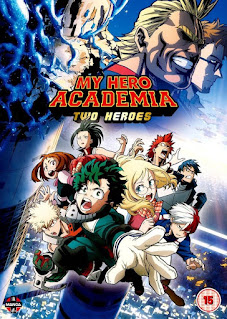
My Hero Academia: Two Heroes is a canon, feature-length film that takes place between the second and third seasons. It focuses on All-Might (voiced by Piccolo and Vegeta dub actor Chris Sabat, who is also the voice of Yami in Black Clover) and Deku (the titular Two Heroes) and their relationships with members of the Shields family, who work as Supporters (usually Quirkless people and tech experts who design costumes and Quirk-augmenting accessories) for Heroes (though not stated until later seasons, it's obvious pretty early in the series that Villains have Supporters, too). They and the main cast of the series receive invitations to a festival on I-Island, a high-security, mobile island used for research and development and extracurricular Hero training. But as often happens when MHA's cast are enjoying down-time, a group of Villains infiltrate the island to steal a Quirk-enhancing MacGuffin. The many twists work well, the action is plentiful and varied—the latter helped by the multiple Villains and large supporting cast—with visuals that match or exceed the quality of the series, and the dynamic between Deku and Melissa Shields (friendship bordering on a propriety-repressed youth romance) is one of the film's highlights. I still ship Deku X Uravity, though.

Not only is Endeavor an inadequate stand-in for All-Might, but the main Villains from Season 4 onward don't match up to the Darth Vader-esque supervillain, All-For-One (the figurehead of the League Of Villains, who can take other people's Quirks for himself or give them to other Villains). He was the peak when it came to evil in the series. Not even the fourth season's Villain, Overhaul (a mafia boss who can deconstruct and re-form anything and anyone he touches, often with graphic—for the series—body horror results) can hope to equal his gravitas and writing quality. The suspense and mystery are still good, Deku's big brother chemistry with Eri (a girl whom Overhaul kidnapped and used as a blood bank for Quirk-suppression ammunition) is sweet, and the fights between Deku and Overhaul are spectacular.


As safe and by-the-numbers as this is, Deku, the courier, and the bird playing off of each other is my favorite part of the movie. The fights look as good as ever, but suffer from the same problems as Made In Abyss: Dawn of the Deep Soul: they drag on for way too long because someone has to transform or clone themselves, or the Hero keeps trying the same attack again and again even though it didn't work the first twelve times. But in the end, Deku says, "you thought Deku would save the day, but it was me, Dio! ORA! ORA! MUDA! MUDA! UNITED ZA WARUDO SAMASHHUU!!!", the courier who betrayed him several times is now another character who's friends with Deku and we'll probably never see again, the cult gets arrested, and their Quirk Trigger bombs get deactivated offscreen. It was good to see this third film go in a different direction (using Humarise as a testing ground for fan reactions to gage how well the show's new Villain organization could be received, and not having Deku do a double-team Finisher for a third time), but there was so much that World Heroes Mission could have done, that the fifth season's second half (and the sixth and seventh seasons) did much better.

But then we get to thinking about Gigantomachia, and the implications of his existence and what would have happened if he succeeded in getting the League where he was commanded to go, and things get crazy. See, on one hand, we have Shigaraki (pun not intended) with All-For-One (who can steal and bestow Quirks) hitching a ride in his enhanced body. On the other hand, we have Gigantomachia, a massive, highly physically adaptable monster who only responds to Shigaraki and All-For-One, and was ordered to bring the members of the League Of Villains directly to the fight between Shigaraki and the Heroes. One might only think of the size and numbers advantage this would bring to an already attrition-heavy battle...but what if, on top of the power he already has, All-For-One used Shigaraki's body to take even Gigantomachia's Quirk(s?), let alone Dabi's fire, the Compress Quirk, or Toga's blood-morphing power (which now lets her use the Quirks of anyone she "loves" whose blood she drinks; save that knowledge for later)? Like, All-For-One wins in that case, right?
Well, thankfully, Shigaraki's willpower is greater than his "Master"'s, and the Heroes manage to kick enough ass before they stop moving that it forces the Villains into a retreat, so the worst case scenario will have to wait until the second half of the season.
With Studio Bones having blown most of their animation budget on the Gunga Villa raid and the Shigaraki fight, Season Six returned with a recap episode and a "tell, don't show" speedrun episode where All-For-One and Shigaraki coordinate multiple prison breaks across Japan, starting with Tartarus (basically MHA's take on The Raft from Marvel Comics with Impel Down nomenclature) where familiar faces like Overhaul from Season Four, the muscle guy Deku went One Million Percent Smash against in Season One, and the big boss himself are held, along with my favorite new minor Villain, the sniper Lady Nagant. She's sexy, she's tragic, and her arm Megatron×Mega Man's into a sniper rifle that fires bullets made of her own hair, which is so cool that I don't care how it actually works.
While Dabi's viral family drama publicity stunt and the mass Villain escapes turn Japan into a paranoid, racist vigilante hellhole that feels eerily contemporary for the season's time of release (the source material for this season was published from 2021 to 2022, a little less than a year before it began airing)—and unfortunately, for the modern day, as well—the gravely injured Heroes are forced to recover from scars both physical and mental, which only stokes more public outrage because selfishness literally Trumps common decency when fear takes control.
Many inconvenient truths come to light for the public and the students at UA High School as Hawks and the Todoroki family face their checkered pasts and Deku goes on a one-man mission to round up the—one moment while I check the exposition dump—ten thousand escaped Villains, pushing his morality and stamina to unprecedented extremes and landing him in Nagant's crosshairs. This anti-hero Deku portion of the season is dripping (literally) with rainy, chaotic atmosphere and an aura farm's worth of mature edginess, and bursting with fluid fight animation as he attempts to sort the redeemable souls from the lost causes, nearly losing himself in the process. It's trial by fire Quirk training and a stress test of his character and how far he's willing to go to save the world from the aspiring Demon Lord (this is what All-For-One calls himself in the dub, but there are other titles that feel more in line with the less supernatural world of MHA, like "great(est) evil" or "true(st) evil;" I don't know spoken Japanese, so correct me if he actually says "Demon Lord" in the original audio). I loved this part of the season and still do...but for one thing: if Shigaraki is just Tetsuo from Akira now, this second half of the season (particularly the amazing Nagant fight) makes it pretty clear that Deku is just Spider-Man with flight, a smokescreen ability, and a few physical amps. I mean, Horikoshi and Studio Bones make no effort to legally distinguish the fact that Deku is web-swinging with the Black Whip Quirk, and his Danger Sense Quirk is just Spider-Sense with the serial number and spiders filed off. It's lazy, derivative, and borderline infringement that's hard to ignore from hereon, but like with the rampant Japravity of Mushoku Tensei, the writing and animation are so good here that it's just as hard to be mad about it. When Deku is at his lonest and wolfiest, and public tensions are at their peak, the literal power of love and friendship brings everyone back to their senses (which isn't nearly as troped out as it sounds), and characters we haven't seen for three seasons or more present unexpected opportunities for victory against All-For-One in the next season.

I really liked the fairy tale angle, Chris Sabat chewing up the recording booth as Dark Might, the ticking clock foreshadowing of Anna's changing hair color, and Deku's Fifty State Ranbu Smash as a finishing move (until the foreshadowed breaking-loose of all Hell completely undercut how cool it looked in the moment). The OP song ("Homunculus" by Vaundy) even slaps hard. But this is definitively my least favorite of the four movies.
There's a short season of recap episodes called Memories that aired as a lead-up to Season Seven, but I don't like clipshow episodes because if I enjoy something, I'd rather just have the full experience of it over again than watch My Hero Academia: the Cliff's Notes Audiobook Edition, so I skipped it. Who needs memories, am I right?

Picking up where the sixth season left off, the caked-up Heroine Star & Stripe tries to face down Shigaraki (still with All-For-One trying to assimilate his consciousness) in a spectacular battle of attrition that she ultimately loses along with her Quirk (an identity-based reality-warping ability called New Order, so insert "Hulk Hogan joins the NWO" reference here), which runs wild through their shared mind and slaughters most of All-For-One's accumulated Quirks. Then it's a "suddenly there was a spy in UA the entire time and we have retcon flashbacks to prove it" story (there's a short-lived red herring that it was the invisible girl, but it's the annoying French kid with a navel laser and his parents because he was born Quirkless and All-For-One leveraged that to get a few more pawns on the board; maybe those comics All-For-One read were by Zenescope? It would explain his penchant for power-bargaining and wanting to be a Demon Lord), followed by "the kids are going somewhere special to train" (like they have at the beginning of almost every season so far) except that that was a trap to split up the League Of Villains into thematically appropriate battles (Uravity & Froppy vs. Himiko Toga, Todoroki vs. Dabi, Endeavor & Hawks vs. All-For-One, a bunch of fodder battles, and a repeat of the Shigaraki fight with Eraserhead nullifying his Quirks from Season Six, but it's even more of an Akira ripoff than before because he has a giant CGI body horror arm made of mouths and fingers now.
From there, Bakugo and a few supporting Heroes get their moments to shine as they wait for Deku to show up because Toga pulled him into the wrong fight. Which means the Shigaraki fight basically looks like the Nappa/Recoome aftermath with more blood when Deku gets there, and he unveils a new Quirk that lets him sound like Luffy when he punches because Gears. The derivative nature of it all doesn't take away from the fact that Bones make every movement and impact look absolutely Plus Ultra.
With the "final blow" of the "final battle" (there have been at least three of these over the course of the series, and Shigaraki/All-For-One still has more in the tank) struck, focus shifts to an unsubtle Black Lives Matter allegory as Heroes and riot police attempt to hold back a citizen army of "heteromorphs" (people whose Quirks give them animalistic, inhuman, or otherwise extranormative physical features) whom the League, Tartarus escapees, and PLF remnants are manipulating into storming a hospital where a Villain with a portal Quirk is being held. The usual, "prejudice is bad, vengeance is bad, social movements are misguided" messaging is at play here, and while it's a natural extension of something minor that was resolved last season (from one point of view) and gives some of the heteromorphic Heroes their moments to shine, it's blatant and disrupts the flow of the larger narrative so the author can get something off his chest (this includes turning Deku and the Todoroki family into a "Quirks are Global Warming" message that a gyaru newswoman literally shouts at the camera—subtle—and making All-For-One the face of global corporate dictatorship).
Things get worse for the Heroes on a numbers and technology front when a disgraced hacker and Toga (using Twice's blood to multiply) disrupt the various fights...but then my favorite stretch of episodes hits and we get to see the effect Deku has had on minor Villains from previous seasons. Nagant makes a surprise return, as do La Brava and Gentle Criminal (a duo from the post-Overhaul material that I honestly thought were filler characters in their debuts). "The Chain Thus Far" is seriously a roller-coaster of emotions and a demonstration of how no character—no person—is unnecessary. Even the movies are given confirmed canonicity with a still shot of the bratty kids from Heroes Rising and a mention of Melissa Shields in the final episode. Unfortunately, this reliance on callbacks and messages and giving everyone a focus results in a season without focus. Sure, we get resolutions to the Todoroki family drama and Uravity's mission to engage Himiko Toga in morally neutral conversation (perhaps the biggest highlights of the season), but there's also a rapidly de-aging All-For-One, the Deku/Shigaraki fight that doesn't get addressed for the last quarter of the season, multiple Heroes dying or losing their Quirks to All-For-One, the unseen public reaction to the Quirk Doomsday Theory from World Heroes Mission playing out on a livestream, and All-Might showing up suddenly to stall All-For-One with an Ironman 3/Age Of Ultron-like Quirk-Buster armor and set up the most anticlimax to ever anticlimax. It felt like there was supposed to be another episode, but that was it; see you in the Final Season for the actual important fights!

Contrary to what I've come to expect from final (and "final") seasons and cours lately, where all we get is a big, dumb, six-hour nuclear screensaver where two people punch laser beams at each other until the "plot" says they can stop, the eighth and final season of My Hero Academia is full of generational symbolism, satisfying character resolutions across the board, and at least two moments that had me unable to breathe and on the verge of tears.
The first thing I really noticed was how the moods of the opening and ending music were swapped. Both are upbeat, but the OP is the more melancholic track ("The Revo" by Porno Graffiti—yes, really—who provided "The Day" for Season One) and the ED theme ("I" by Bump Of Chicken—yes, really) is the more hype rock jam of the two, when it's more common to have tones trend in the opposite direction, so it's like even the music is saying "this is the end of an era."
That sentiment continues as the fight between All-For-One (able to regenerate because of a duplicate of Eri's Quirk that makes him younger and stronger as he takes damage)

and All-Might (wearing the nanotech Quirk-Buster armor Melissa Shields made for him) picks up right where it cliffhangered the previous season, with both men locked in a battle of attrition to the death until Stain of all people (and Bakugo, who's wearing plot armor because another hero stitched his body back together and he restarted his own heart with a bead of explosive sweat in his bloodstream—which is apparently a biologically impossible place for your sweat to be) shows up to even the playing field...until he doesn't, but it's still a Moment. As spoiled in the Reze Death Battle, Bakugo ends up being the one to take out All-For-One (who looks like a Castlevania body horror boss by now) with a combination of his personality (yelling, punching, and flashy explosions that make him look like he's going relativistic speeds even though he's probably not) and that episode of Spider-Man: The Animated Series where Silvermane turns into a baby. Bakugo announcing himself with Deku's nickname for him was a nice touch, too.
But with All-For-One having side-evolved from a parasitic fanboy (he literally stole his little brother's Quirk and nutrition at birth, stole his mother's Quirk and the Quirk of Patient Zero as a child, claimed ownership of his brother, and stole the Demon Lord title from the comics he read) into an overly emotional crybaby that was poofed from existence by his own crashout against a flame-war expert like he's a WatchMojo employee, it seems his Reverse Flash-meets-Vince McMahon schemes of vicarious conquest


Aside from the generational, toxic fandom commentary, there's also some massive callback stuff like Gentle Criminal giving Deku the last boost before the last hit and Eri using her Quirk to regrow Deku's Decayed arms (Overhaul lost his arms fighting Deku in Season Four), and tons of supporting cameos from throughout the series and movies.
Even the cooldown episodes (the Todoroki family going to visit Dabi in rehab-prison, Uraraka dealing with her repressed feelings about Toga's death and counseling new Quirk users, the eponymous "where are they now?" finale, and the "More" epilogue where Deku becomes a teacher and confesses his feelings for Uraraka) felt substantial and worth watching.
I've seen a lot of negative feedback about My Hero's ending, talking about how it doesn't do Deku justice or wrap up the story in a satisfying way, and I don't get the hate.
MHA has always been about legacy, studying history, and learning from the mistakes of the past. Bakugo, Iida, and Todoroki are family legacies. Bakugo and Deku are rivals for All-Might's Hero legacy. Deku overcame the limits of his abilities by studying others and preparing accordingly in the moment or offering suggestions on how they can improve in the future. The Villains ultimately lost because All-For-One treated mistakes either as disposable events and people or as something he was too superior to be capable of himself. Villains in general rose up because of systemic neglect and the persecution of the different in what essentially became a self-congratulatory, meritocratic society with the appearance of Quirks. All-For-One and One-For-All were diametrically opposing forces from that tragically flawed legacy era with an unsustainable, toxic symbiosis, so the point of Deku's journey was never to be "The Next All-Might." His Hero name told us as much from the beginning: you don't need to wait for a Hero to do something because even a good-for-nothing can do anything. In a world that's fallen to ruin, something as small as asking your asshole brother his favorite food, encouraging someone who isn't sure if they're good enough, giving counseling services to those in need, or lending a helping hand to brighten someone's day, can make that terrible time a little less terrible until the compounded good eventually outweighs the bad. And showing that you love what you do because you do what you love doesn't hurt, either. That's who and what Deku is, even to the Villains in his life. That's his legacy for the world. And that's what My Hero Academia's ending means to me.
Am I interested in seeing a third season of Vigilantes? Might it be compelling to peer more into other aspects of My Hero Academia's past (like the period when All-For-One ruled and was working his way through the first Eight Users)? Yes on both accounts. But I, For One, am also more satisfied than most with what the main series did give us, subversions, messaging, and All.
Please Stay Tuned for a return to single-issue Retrospectives, a TBT '26 mashup, and more Goj-Year-ra with Mechagodzilla. My new view goalpost for May is going to be fifteen thousand (thank you for continuing to be awesome by the daily thousands!), so please remember to Become A Ticketholder if you haven't already, leave a comment at the bottom of this post and any others you have opinions about because I AM HERE to read them, help out my ad revenue as you read because I'd appreciate the Support, and follow me on BlueSky, Tumblr, Facebook, Instagram, Pinterest, YouTube, and LinkedIn to like what you see, receive the latest news on my Quirky content, and get me closer to that new goal.
59
Animeister,
Out.


Comments
Post a Comment